Delpatch
Delpatch Elastomeric Concrete
Delpatch
A permanent repair method for concrete pavement using elastomeric concrete that minimizes construction time and traffic control. It can be used for airport runways, taxiway lighting, joint filler, and emergency highway repair materials.
Key Features & Advantages
Heavy Load Capacity
Suitable for heavy vehicles meeting airport standards C-4, 747
Spalling Resistance
Long-life repair material for high-performance pavement repair
Adhesion to Concrete & Steel
Withstands 400psi on concrete and 500psi on steel in testing
Impact Resistance
Unlike epoxy or concrete-based materials, withstands strong impacts even in extremely cold conditions
High Compressive Strength
Can withstand high pressure before deformation, and memory system restores nearly to original state after deformation
Ease of Application
Self-leveling with rapid curing time allows traffic opening within 1 hour after final placement
Elasticity
Cement and epoxy-based materials damage repair areas due to high rigidity. Delpatch concrete uses special urethane chemistry to provide elastic patching that contracts and expands without damaging surrounding concrete
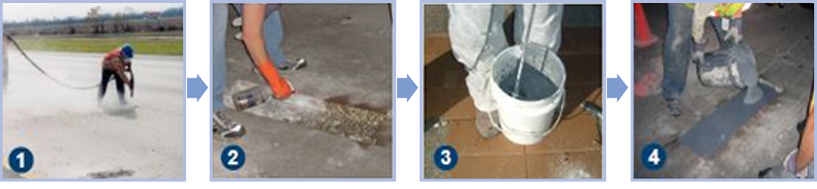
Construction Method
Area Selection
Cut and chip the work area, then allow to dry.
Primer Application
Apply primer using spray or brush. Allow minimum 30 minutes drying after primer application. Do not exceed 4 hours after primer application.
Mixing
Mix 3,000ml of Component A with 1,500ml of Component B for 10 seconds. Add 1 bag of pre-measured 10kg sand/fiberglass and mix for 1 minute. (Properly mixed Delpatch elastomeric concrete shows a uniform gray color.)
Placement
Apply by progressively filling the repair area. Delpatch elastomeric concrete is self-leveling. Traffic can be opened within 1 hour after final placement. Delpatch elastomeric concrete cannot be applied in moisture or below 8 degrees C.
Quality Specifications
| Test Item | Quality Standard | ASTM Test Method |
|---|---|---|
| Tensile Strength, min., MPa | Min. 4.14 | D 412 (mod) |
| Elongation, min. % | Min. 25 | D 412 (mod) |
| Durometer Hardness (Type D), points | Min. 50 | D 2240 |
| Compressive Properties, MPa, 5% Deflection | Min. 5.5 / Max. 9.6 | D695 |
| Recovery, 5% Deflection | Min. 0.66 | D695 (mod) |
| Impact, Ball Drop @-29°C, No Cracking | > 3m | D3029 (mod) |
| Concrete Bond Strength MPa (Dry Bond) | Min. 2.76 | - |
| Concrete Bond Strength MPa (Wet Bond) | Min. 1.72 | - |
Delivery Records
| Airport | Project | Quantity | Year |
|---|---|---|---|
| Alliance Airport, TX | Runway Extension | 120 units | 2017 |
| Austin Bergstrom Airport, TX | Taxiway A | 70 units | 2015 |
| Blytheville-Gosnell Arkansas Airport | Lighting trench | 80 units | 2012 |
| Dallas Love Field, TX | Taxiway C | 150+ units | 2011, 2018 |
| Detroit Metro International Airport | Taxiway K | 150+ units | 2004 |
| Harrisburg International Airport, PA | Taxiway and holding area | 75 units | 2015 |
| Los Angeles International Airport | Runway 25R Reconstruction project | 100+ units | 2017, 2018 |
| McConnell AFB, KS | Phase B Edge light | 45 units | 2014 |
| Memphis International Airport | Numerous projects | 250+ units | 1998-2018 |
| Minneapolis St. Paul Airport | MSP Airport 2014 Airside Bituminous/Electrical Construction | 100+ units | 2014 |
| Phoenix Sky Harbor | Light Can core repairs | 20 units | 2009 |
| Salt Lake City Airport | Taxiway extension | 250+ units | 2008, 2011 |
| Sioux Falls ANG | Centerline Lighting | 90 units | 2003 |
| St. Louis Lambert International Airport | National Guard - Lighting trench | 50 units | 2013 |
| Stewart Airport | Airfield Lighting Can rehab | 25 units | 2010 |
| Washington Dulles International Airport | Runway 1R 19L - Centerline Lighting | 140 units | 2009 |